There are community events—and then there are moments when a people show up, stand tall and make their culture impossible to ignore.
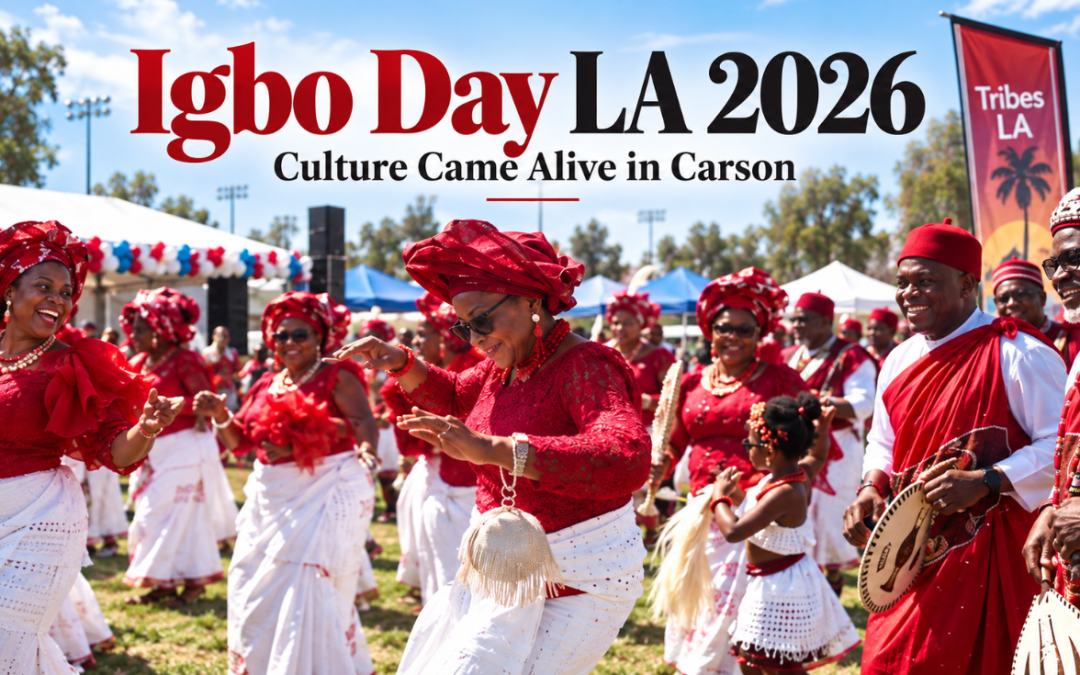
That was the energy at Igbo Day Festival 2026, where Southern California’s Igbo community transformed Veterans Memorial Park in Carson into a colorful celebration of heritage, identity and togetherness.
Held on Saturday, August 29, 2026, the festival brought families, community leaders, cultural groups, entrepreneurs and friends of the Igbo community together for an afternoon built around traditional displays, music, dancing, folklore, cuisine and masquerade culture.
And from the scenes captured at the festival, one thing was immediately clear: Ndigbo came prepared to celebrate.
The open field became a living showcase of Igbo culture. Traditional attire added brilliant splashes of red, white, green and richly patterned fabrics. Groups moved through the grounds in coordinated performances. Music and dancing pulled spectators into the atmosphere, while cultural presentations reminded everyone that Igbo heritage is not something preserved only in books or memories—it is still being lived, performed and passed forward.
The festival also demonstrated something increasingly important for the diaspora: culture survives when community creates spaces for it.
For Igbo families raising children thousands of miles from southeastern Nigeria, gatherings like Igbo Day provide something that cannot easily be recreated online. Children get to see the clothing. Hear the music. Watch traditional dances. Encounter customs and ceremonies. Taste the food. Meet elders. And, perhaps most importantly, see hundreds of people proudly saying through their presence: this is part of who we are.
That matters enormously in Southern California.
The Igbo population across Los Angeles and surrounding communities is spread across a vast metropolitan region. People belong to hometown associations, professional networks, churches, social clubs and cultural organizations, but geography can sometimes keep those communities in separate circles. Igbo Day creates a larger meeting ground—a place where those circles can intersect.
It is part reunion, part cultural classroom and part community marketplace.
Local businesses and vendors also become part of the story. Food sellers, caterers, fashion entrepreneurs, artists and small-business owners gain an opportunity to introduce their work to a concentrated community audience. One attached festival promotion, for example, invited guests to support a participating pastry business while enjoying the celebration.
That economic dimension should not be overlooked. Strong cultural gatherings can become platforms not just for entertainment, but for community commerce, networking, sponsorship, youth engagement and organizational collaboration.
But perhaps the biggest takeaway from Igbo Day LA is simpler.
For a few hours in Carson, Southern California felt a little closer to home.
The dancing, the attire, the greetings, the laughter and the gathering of generations carried a message bigger than the festival itself:
Igbo culture is alive in Southern California—and the next generation is being invited into the story.
Igbo Kwenu!
For Tribes LA, events like this are exactly why documenting our community matters. The celebration may end at 6 p.m., but the photographs, videos, people, organizations and stories deserve to remain discoverable long after the tents come down.